AI search has fundamentally changed how people discover businesses, products and services.
A potential customer no longer has to type a keyword into Google, scan ten blue links and compare websites manually. Increasingly, they can ask ChatGPT, Gemini, Perplexity, Google AI Mode, Google AI Overviews or Microsoft Copilot a question and receive a synthesized recommendation.
That creates a new marketing challenge:
Does your brand appear when your customers ask AI for a recommendation?
And perhaps even more importantly:
Does AI cite your website as a source?
This is where Generative Engine Optimization (GEO) and AI visibility monitoring have emerged as important parts of modern digital marketing.
In 2026, marketers have a growing number of platforms designed to answer these questions. Among the most relevant are:
- Microsells GeoPro
- Profound
- Peec AI
- OtterlyAI
- Semrush AI Visibility
- Ahrefs Brand Radar
Although these products overlap, they are not identical.
Some specialize in AI-search intelligence. Others combine AI visibility with traditional SEO. Some focus primarily on monitoring, while others extend into optimization and broader marketing workflows.
This guide compares them across the capabilities that matter most to businesses, agencies and marketing teams in 2026.
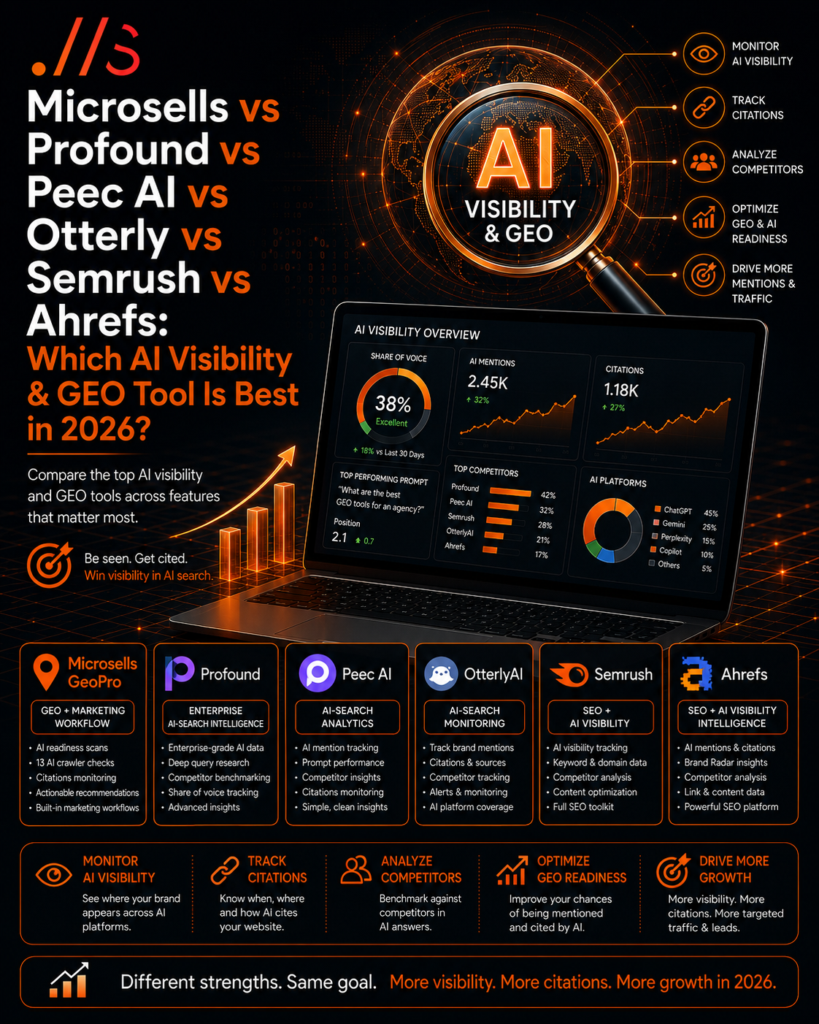
Quick comparison: Microsells vs Profound vs Peec AI vs Otterly vs Semrush vs Ahrefs
| Platform | Primary focus | AI visibility | Citation tracking | Competitor analysis | GEO optimization | Traditional SEO | Broader marketing |
|---|---|---|---|---|---|---|---|
| Microsells GeoPro | GEO + marketing workflow | ✓ | ✓ | ✓ | ✓ | Supporting | ✓ |
| Profound | Enterprise AI-search intelligence | ✓ | ✓ | ✓ | ✓ | — | — |
| Peec AI | AI-search analytics | ✓ | ✓ | ✓ | ✓ | — | — |
| OtterlyAI | AI-search monitoring | ✓ | ✓ | ✓ | ✓ | — | — |
| Semrush | SEO + AI visibility | ✓ | ✓ | ✓ | ✓ | ✓ | ✓ |
| Ahrefs | SEO + AI visibility intelligence | ✓ | ✓ | ✓ | ✓ | ✓ | — |
The important point is that a feature checkmark doesn’t necessarily mean the products work in exactly the same way.
The real difference is how each platform approaches AI visibility.
What is AI visibility?
AI visibility measures how often and how prominently a brand appears in AI-generated answers to relevant questions.
For example, imagine someone asks:
“What are the best GEO tools for an agency?”
An AI system might mention:
- Platform A
- Platform B
- Platform C
and cite several websites supporting the answer.
A traditional SEO platform might tell you where your website ranks for:
“best GEO tools”
An AI visibility platform asks a different question:
When people ask AI this question, does my brand appear in the answer?
This can involve measuring:
- Brand mentions
- Share of voice
- Position in AI responses
- Sentiment
- Citations
- Cited domains
- Competitor mentions
- Prompt performance
- Geographic differences
- AI-platform differences
GEO goes one step further by asking how a company can increase the probability of being mentioned and cited.
Microsells GeoPro
Best for: Businesses and agencies looking for GEO monitoring, AI readiness and optimization within a broader marketing environment.
Microsells approaches GEO from a practical marketing perspective.
Its GeoPro platform analyzes a website’s AI-search readiness, checks access for major AI crawlers, tracks queries and citations surfaced by AI platforms, and provides recommendations intended to improve citeability. Microsells says GeoPro currently checks 13 AI crawlers and combines AI readiness with SEO and marketing-technology analysis.
Its workflow is built around four important stages:
Scan → Score → Prioritize → Track
That means the product isn’t positioned solely as a dashboard showing whether a brand is visible.
It is also designed to identify issues that could affect AI discoverability and provide actionable recommendations.
Key GeoPro capabilities
According to Microsells, GeoPro includes:
- AI-search readiness analysis
- AI crawler accessibility checks
- Citation tracking
- ChatGPT and Gemini query simulation
- AI citeability scoring
- Schema and FAQ generation
- GEO content recommendations
- SEO analysis
- Marketing-technology analysis
- Prioritized optimization recommendations
This makes GeoPro particularly interesting for businesses that want to connect AI visibility measurement with actual optimization work.
Who should consider Microsells?
Microsells is particularly relevant for:
- SMBs
- Marketing teams
- Digital agencies
- Freelancers
- Consultants
- Businesses managing multiple marketing channels
- Teams that want GEO alongside other marketing tools
Microsells also positions GeoPro alongside its other products, including social media planning and Google Ads campaign generation, creating a broader marketing workspace rather than a standalone AI-search analytics product.
Microsells vs Profound
Best comparison: practical GEO optimization vs enterprise AI-search intelligence
Profound is one of the platforms most strongly associated with enterprise AI-search intelligence.
Its focus is understanding how brands, products and organizations are represented across generative search.
This makes Profound particularly relevant to larger organizations where AI visibility is becoming a dedicated marketing or brand-intelligence function.
Profound is a strong choice for:
- Enterprise AI-search monitoring
- Large-scale brand intelligence
- Competitive analysis
- AI-search reporting
- Understanding brand representation
- Enterprise GEO programs
Where Microsells differs
The distinction is primarily one of scope and workflow.
Profound is heavily focused on AI-search intelligence.
Microsells places GEO inside a broader marketing environment.
For an enterprise organization asking:
“How is our brand represented across AI search at scale?”
Profound can be an attractive choice.
For a marketing team asking:
“How visible are we in AI search, what is preventing us from being cited, and what can we do about it?”
Microsells’ more action-oriented GeoPro workflow may be more appropriate.
Choose Profound if:
Your primary requirement is enterprise-grade AI-search intelligence.
Choose Microsells if:
You want AI visibility monitoring connected directly to GEO optimization and broader marketing activities.
Microsells vs Peec AI
Best comparison: integrated marketing workflow vs specialized AI-search analytics
Peec AI is specifically built around AI-search analytics.
The platform focuses on measuring brand performance across AI platforms and provides metrics intended to help marketing teams understand their visibility.
Peec currently markets itself as an AI-search analytics platform for marketing teams and agencies, with tracking and analysis capabilities for brand performance across AI platforms.
Its platform emphasizes:
- AI visibility
- Competitor analysis
- Prompt tracking
- Citation analysis
- Brand sentiment
- Source analysis
- Reporting
- Agency workflows
Peec also publishes dedicated agency plans designed around multi-brand tracking and white-label reporting.
Where Peec AI stands out
Peec is a compelling option when AI-search analytics is the central requirement.
A marketing team can use it to answer:
“How visible is our brand?”
“Which competitors are more visible?”
“Which sources are AI systems using?”
“How does our visibility change over time?”
Where Microsells differs
Microsells combines GEO monitoring with a broader marketing workflow.
The difference can therefore be summarized as:
Peec AI → specialized AI-search analytics
Microsells → GEO + optimization + broader marketing workflow
Neither approach is inherently better.
It depends on whether AI-search analytics is your entire requirement or one part of a larger marketing operation.
Choose Peec AI if:
You want a specialized platform for AI-search performance measurement and competitive analysis.
Choose Microsells if:
You want AI visibility to connect with practical GEO optimization and other marketing activities.
Microsells vs OtterlyAI
Best comparison: broader marketing workflow vs dedicated AI-search monitoring
OtterlyAI is another specialist platform focused on monitoring brand visibility in AI search.
Its current platform says it tracks seven major AI search engines:
- ChatGPT
- Google AI Overviews
- Google AI Mode
- Gemini
- Perplexity
- Microsoft Copilot
- Claude
It also supports monitoring across 65+ countries and languages.
Otterly’s pricing currently starts at $29/month, with its published plans scaling by prompt volume and capabilities.
OtterlyAI is particularly useful for:
- AI-search monitoring
- Prompt tracking
- Brand mentions
- Competitor monitoring
- Citation tracking
- Geographic monitoring
- AI-search optimization
- Agencies
This makes Otterly an interesting choice for organizations that want a dedicated AI-search monitoring tool without adopting a larger SEO platform.
Where Microsells differs
Microsells is broader in its positioning.
GeoPro combines:
AI visibility → AI readiness → optimization → broader marketing
rather than treating AI monitoring as an isolated analytics function.
Choose OtterlyAI if:
Your primary goal is dedicated AI-search monitoring across multiple AI platforms and markets.
Choose Microsells if:
You want GEO monitoring and optimization integrated with a broader marketing workflow.
Microsells vs Semrush
Best comparison: focused GEO workflow vs all-in-one SEO and AI marketing ecosystem
Semrush is probably the most obvious comparison for marketers already using traditional SEO software.
The platform has expanded significantly into AI visibility.
Its AI Visibility Toolkit currently includes:
- AI visibility reports
- AI brand performance
- AI sentiment
- AI mentions
- Citation analysis
- Competitor gaps
- Prompt research
- Custom prompt tracking
Semrush lists its dedicated AI Visibility toolkit starting at $99/month per domain, while its broader SEO + AI Search plans start at higher price points.
Why Semrush is powerful
The biggest advantage is breadth.
Semrush combines AI visibility with:
- Keyword research
- SEO
- Competitor research
- Site auditing
- Position tracking
- Content marketing
- PPC
- Local SEO
- Marketing reporting
This creates an important advantage:
AI visibility doesn’t have to exist separately from SEO.
A marketer can analyze traditional search visibility and AI visibility in the same ecosystem.
Semrush’s AI visibility capabilities
Semrush’s current AI Visibility offering allows marketers to track custom prompts and analyze brand visibility, mentions, citations and competitor opportunities.
Its broader SEO + AI Search plans also include daily prompt tracking and AI-ready site auditing.
Where Microsells differs
Microsells doesn’t need to beat Semrush at every SEO feature.
Instead, its opportunity is specialization.
GeoPro is designed specifically around:
Can AI systems access, understand and cite my business—and what should I fix?
This makes the two platforms particularly different in philosophy.
Choose Semrush if:
You want a mature SEO and digital-marketing ecosystem with AI visibility integrated into it.
Choose Microsells if:
You want a more focused GEO workflow that combines AI readiness, citation tracking and optimization with practical marketing tools.
Microsells vs Ahrefs
Best comparison: GEO workflow vs SEO research + large-scale AI visibility intelligence
Ahrefs has made AI visibility a significant part of its product strategy through Brand Radar.
The current Brand Radar product allows marketers to research brands across hundreds of millions of AI prompts and track custom prompts.
Ahrefs currently advertises 470M+ organic prompts in its AI Visibility Index.
Its current pricing information lists Brand Radar from approximately £159/month for the AI Visibility Index, while individual platform access and broader packages can cost considerably more. Ahrefs’ help documentation currently lists single-platform access at $199/month per index and an all-platform option at $699/month.
Ahrefs’ biggest advantage
Data.
Ahrefs has spent years building one of the largest SEO datasets in the industry.
Brand Radar extends that philosophy into AI visibility.
The platform can connect:
- AI visibility
- Search demand
- Organic visibility
- Backlinks
- Content
- Competitors
- AI citations
This is particularly powerful for SEO teams.
Ahrefs Brand Radar
Brand Radar can analyze AI visibility using large prompt databases and also supports custom prompts for more specific queries.
Ahrefs has also continued expanding Brand Radar during 2026, including additional AI platforms and combined visibility reporting.
Where Microsells differs
The distinction is again about the workflow.
Ahrefs is exceptionally strong for:
Research + data + SEO + AI visibility
Microsells is focused on:
AI readiness + GEO + optimization + marketing workflow
Choose Ahrefs if:
You are an SEO-heavy organization and want to connect traditional search intelligence with AI visibility data.
Choose Microsells if:
You want a GEO-first workflow that focuses on improving AI citeability and connecting those improvements to broader marketing activities.
Feature-by-feature comparison
AI visibility monitoring
All six platforms address AI visibility, but their approaches differ.
Microsells: Focuses on tracking relevant AI queries and citations while also analyzing website AI readiness.
Profound: Strong enterprise-oriented AI-search intelligence.
Peec AI: Strong prompt-level analytics and competitive AI-search measurement.
OtterlyAI: Strong multi-platform monitoring, with current support for seven major AI search engines.
Semrush: AI visibility integrated with SEO and competitive research.
Ahrefs: Large-scale AI visibility research combined with traditional search data.
Citation tracking
Citation tracking is becoming one of the most important GEO metrics.
A simple brand mention isn’t necessarily enough.
A more valuable outcome is:
AI mentions your brand and cites your website as evidence.
Microsells explicitly tracks citations surfaced by ChatGPT and Gemini and incorporates citation-related analysis into GeoPro.
Peec, OtterlyAI, Semrush and Ahrefs also provide varying forms of source and citation analysis.
The important distinction is whether the platform helps you understand:
- Which pages are being cited?
- Which competitors are being cited?
- Which third-party websites influence the answer?
- What content gaps exist?
- What should you do next?
That final step is where GEO optimization becomes much more valuable than monitoring alone.
Competitor analysis
AI search is inherently competitive.
If a user asks:
“What is the best GEO software?”
you don’t only want to know whether your brand appears.
You want to know:
Who appears instead?
All five major comparison competitors offer some form of competitor analysis.
Semrush, for example, explicitly highlights competitor gaps and opportunities within its AI Visibility product.
Peec also emphasizes competitive AI-search performance.
Ahrefs connects AI visibility with broader competitor and search data.
For businesses, this is arguably one of the most valuable use cases for a GEO platform.
GEO optimization
Monitoring tells you what happened.
Optimization attempts to change what happens next.
This is an important distinction.
Microsells’ GeoPro takes an explicitly optimization-oriented approach, with AI-readiness scoring, crawler checks and prioritized recommendations around issues such as blocked crawlers, missing schema and weak content structure.
That makes GeoPro particularly relevant for teams that want a diagnostic and optimization workflow rather than only an analytics dashboard.
Pricing comparison
Pricing changes frequently, so businesses should verify the current plan before purchasing.
Based on the vendors’ current published information:
| Platform | Current published starting point / indication |
|---|---|
| Microsells GeoPro | See current Microsells pricing |
| Profound | Enterprise-oriented / contact-based |
| Peec AI | Paid plans vary by prompts, projects and tracking configuration |
| OtterlyAI | Starts at $29/month |
| Semrush AI Visibility | Starts at $99/month per domain |
| Ahrefs Brand Radar | Starts around $159/month for AI Visibility Index; individual platform access can be higher |
OtterlyAI currently publishes $29/month as its starting price.
Semrush currently lists its dedicated AI Visibility product from $99/month per domain.
Ahrefs currently lists Brand Radar AI Visibility Index from £159/month, while its help documentation lists single-platform access at $199/month per index and all-platform access at $699/month.
For Peec AI, pricing depends on the configuration of prompts, models, projects and tracking frequency, with separate agency options.
Important: pricing should not be the only basis for comparison. Prompt volume, models, refresh frequency, geographic coverage and reporting limits can significantly affect the real cost.
Which platform is best for agencies?
Agencies have a different requirement from an individual business.
An agency may need:
- Multiple client projects
- Competitor monitoring
- Scheduled reporting
- White-label reports
- Multiple users
- Geographic tracking
- Repeatable GEO audits
- Optimization workflows
Peec explicitly offers agency configurations with multiple projects and white-label reporting.
OtterlyAI also targets agencies with its higher-tier plans and multi-market monitoring.
Microsells has an additional advantage for agencies that want GEO alongside other marketing functions because its product suite includes GeoPro, social media planning and Stagtiks for Google Ads campaign generation.
For agencies, therefore, the decision should be based on whether the priority is:
Dedicated AI-search intelligence
or:
GEO + broader client marketing workflow.
Which platform is best for small businesses?
Small businesses generally don’t need the same depth of enterprise intelligence as a multinational brand.
They need practical answers:
- Where do I appear?
- Why don’t I appear?
- Who is beating me?
- Which pages need improvement?
- What should I do next?
This makes an actionable GEO workflow particularly valuable.
Microsells GeoPro is designed around this type of diagnostic process, starting with a website scan and AI-readiness score before prioritizing issues and tracking AI-search results.
OtterlyAI is another attractive option for smaller businesses that mainly need AI-search monitoring, with published pricing beginning at $29/month.
Semrush and Ahrefs become particularly attractive when a business also needs substantial traditional SEO capabilities.
Which platform is best for SEO teams?
This category is easier.
If traditional SEO remains a major part of your workflow, Semrush and Ahrefs have a major advantage.
Both already have mature ecosystems around:
- Keywords
- Backlinks
- Competitors
- Technical SEO
- Content
- Search demand
and are now adding AI visibility capabilities.
Ahrefs in particular connects Brand Radar with its broader search and web-visibility data.
Semrush similarly integrates AI visibility with SEO and competitive intelligence.
For an SEO-first team, that ecosystem integration can be more valuable than using a standalone GEO platform.
Which platform is best for GEO-first teams?
This is where the decision becomes more nuanced.
If your primary objective is:
Measure AI visibility, understand citations, identify AI-search problems and improve your website’s ability to be discovered and cited
then a GEO-first platform can be attractive.
Microsells GeoPro is explicitly designed around AI-search readiness and citeability.
Peec and OtterlyAI are also strong options when the priority is dedicated AI-search measurement and monitoring.
Profound becomes particularly relevant as the organization scales toward enterprise AI-search intelligence.
The most important metric isn’t simply “AI visibility”
One mistake businesses make when entering GEO is treating visibility as a single number.
It isn’t.
A useful AI-search measurement framework should consider at least:
1. Mention rate
How often does AI mention your brand?
2. Position
Where does your brand appear in the answer?
3. Share of voice
How frequently do you appear compared with competitors?
4. Sentiment
How does AI describe your company?
5. Citation rate
How often is your website cited?
6. Citation quality
Which pages are being cited?
7. Citation share
How frequently are you cited compared with competitors?
8. Platform visibility
Do you appear in ChatGPT but not Gemini?
Do you appear in Google AI but not Perplexity?
9. Geographic visibility
Does your visibility change between countries or markets?
10. Topic visibility
Are you visible for your most commercially valuable questions?
This is why a single “AI visibility score” should never be the only KPI.
What should businesses actually optimize for?
The ultimate objective isn’t:
“Get a high GEO score.”
It is:
Become a trusted source that AI systems consistently mention and cite when customers ask commercially relevant questions.
That requires more than adding keywords.
A successful GEO strategy may involve:
- Improving content depth
- Answering specific customer questions
- Strengthening entity clarity
- Adding structured data
- Ensuring AI crawlers can access important content
- Building authoritative third-party mentions
- Publishing original research
- Creating useful comparison content
- Strengthening topical authority
- Improving factual consistency
- Building reputable external references
- Monitoring AI citations continuously
This is why GEO should be treated as an ongoing marketing discipline rather than a one-time technical audit.
The future of GEO: from rankings to recommendations
Traditional SEO created a world where marketers competed for:
Position #1
AI search creates a different competitive environment.
Now marketers increasingly compete to become:
The company AI recommends.
That changes the strategy.
The question isn’t simply:
“Can Google find us?”
It becomes:
“Can AI understand who we are?”
Then:
“Does AI consider us relevant?”
Then:
“Does AI mention us?”
And finally:
“Does AI trust our website enough to cite it?”
This progression—from discovery to recommendation to citation—is at the heart of modern GEO.
Final verdict: Which GEO platform should you choose?
There is no universal winner.
Each platform has a different center of gravity.
Microsells GeoPro
Best for: GEO + AI readiness + optimization + broader marketing workflows.
Choose Microsells if you want a practical GEO platform that goes beyond monitoring and connects AI visibility with broader marketing activities.
Profound
Best for: Enterprise AI-search intelligence.
Choose Profound if your organization needs deep enterprise-level monitoring and intelligence around generative search.
Peec AI
Best for: Dedicated AI-search analytics.
Choose Peec if you want detailed prompt-level AI visibility, competitive analysis and reporting, particularly in an agency or marketing-team environment.
OtterlyAI
Best for: Accessible AI-search monitoring.
Choose OtterlyAI if you primarily need to monitor brand visibility across multiple AI search engines and markets, with published plans starting at $29/month.
Semrush
Best for: SEO + AI visibility.
Choose Semrush if you want AI visibility integrated into an established SEO, competitive research and marketing ecosystem.
Ahrefs
Best for: SEO data + large-scale AI visibility intelligence.
Choose Ahrefs if you want to combine AI visibility research with a powerful traditional SEO and search-data ecosystem.
Conclusion
The emergence of AI search doesn’t mean traditional SEO is dead.
It means search has become more complicated.
Businesses now need to understand two interconnected environments:
Traditional search visibility
and
AI-generated visibility.
Platforms such as Semrush and Ahrefs are bringing AI visibility into established SEO ecosystems.
Platforms such as Profound, Peec AI and OtterlyAI are specializing in AI-search intelligence and monitoring.
Microsells takes a GEO-first approach that combines AI-search readiness, citation tracking and optimization with a broader marketing workflow.
The right platform depends on your business model and goals.
But regardless of which platform you choose, one principle is becoming increasingly important:
Don’t optimize only to rank. Optimize to be understood, recommended and cited.
Because in the next generation of search, the most valuable position may not be the first blue link.
It may be the brand an AI assistant recommends first—and the source it cites to prove it.